Conference of the month: John Fullerton
What if we used the universal principles and patterns underlying stable, healthy, and sustainable living systems as a model for economic-system design?
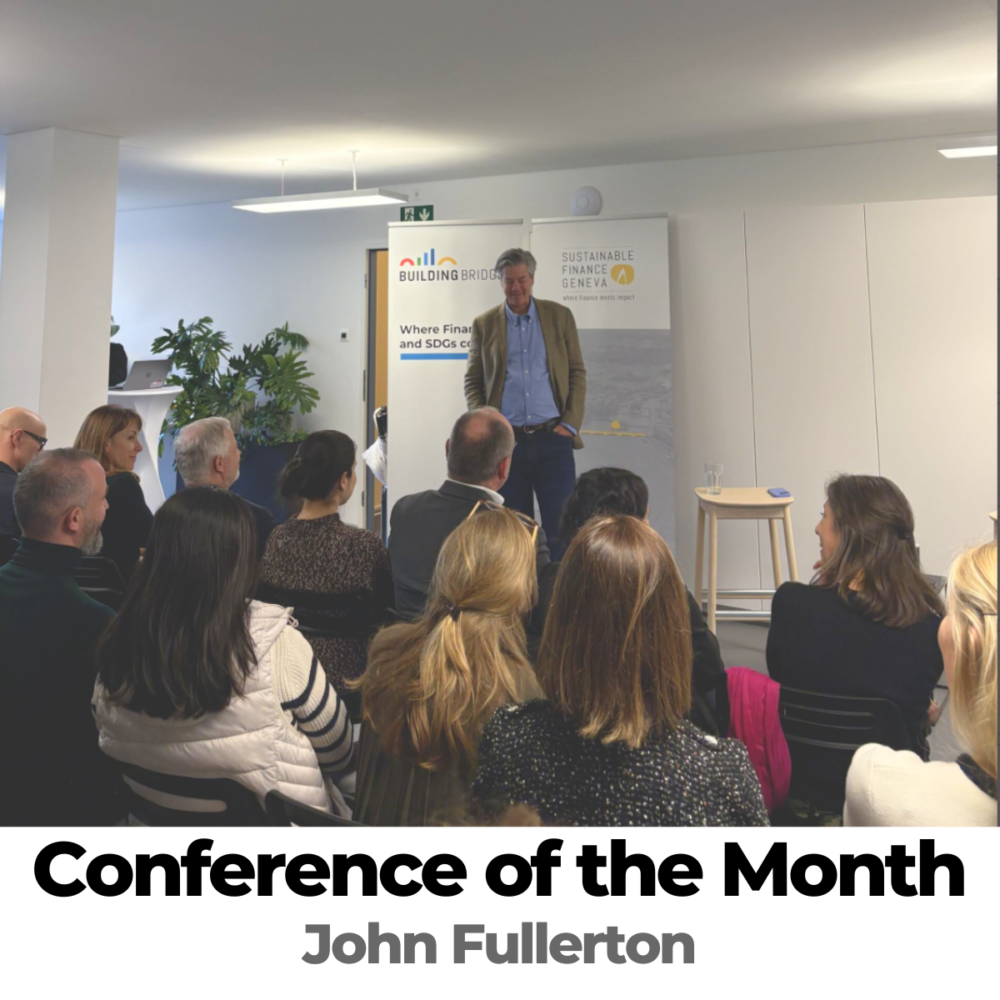
That was the topic at the heart of our recent conversation with John Fullerton, founder of the Capital Institute and a pioneer thinker on the future of the economy, when he visited Geneva to launch his new book Regenerative Economics: Revolutionary Thinking for a World in Crisis.
John came to this work through an unexpected path: a long career at JP Morgan, where he eventually led major capital markets operations before walking away from it all. In the years that followed, he arrived at a conclusion that has driven everything since: the global economy as currently configured cannot continue. Not as an ethical argument, but as a matter of physics. Infinite growth is not possible on a finite planet.
We have been treating the economy like a machine, when it should function as a living system. Machines are complicated; life is complex. The economic tools we have built over the last century, including our risk models, our discount rate frameworks, and GDP, were designed for complicated problems and cannot adequately manage an increasingly complex future. This, John argues, is how we have arrived at our current polycrisis: political, social, economic, and ecological challenges cascading simultaneously.
The transition ahead, he suggests, is not about incremental reform. It requires transformation. The right analogy being metamorphosis. When a caterpillar transforms, its immune system, the very thing that protects it, must dissolve before something new can form. The financial system is the immune system of our current economy. Breaking it down and figuring out what a new, fit-for-purpose system should look like is the central task of our time.
The principles of regenerative vitality that John has developed offer a starting point for how we can go about this monumental feat. They are not laws, but observable patterns drawn from living systems: the importance of relationships over parts (in right relationship), the value of resilience over pure efficiency (dynamic balance), and the recognition that the weakest link in a system determines its overall health, not the strongest.
John finished on a note of hope: it only takes 7% for a tipping point to occur. 7% of people to be committed to building something new. Each of us must do our individual work and journey, and luckily young people will find this shift far easier than those trained under the old paradigm.
We left the room with a lot to think about. And the sense that thinking differently is exactly where we need to start.
If you are interested in John’s work, visit his website where you can find his book and online courses.