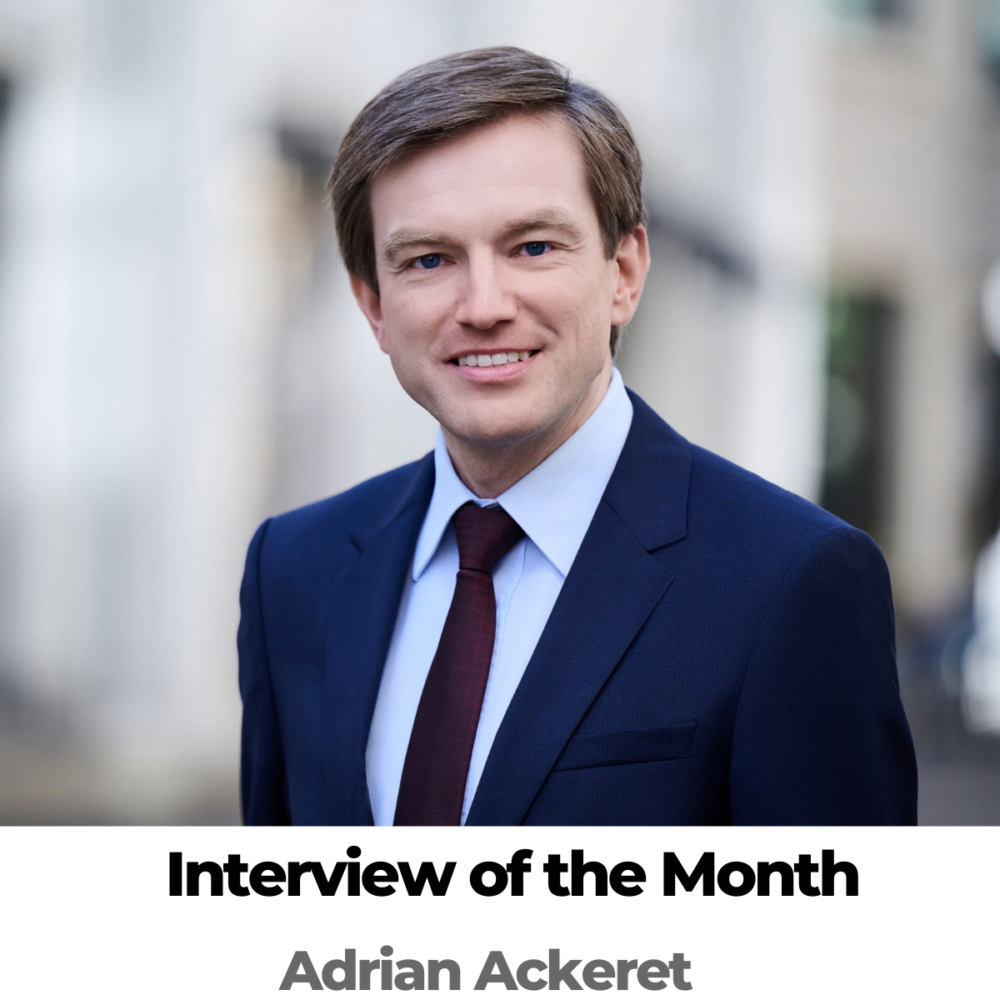
Interview of the Month: Adrian Ackeret
This interview of Adrian Ackeret, partner at elea, explores how the organization uses philanthropic capital in an entrepreneurial way to fight absolute poverty. It sheds light on elea’s catalytic investment approach, combining early-stage capital with deep strategic support to help impact ventures become financially sustainable and scalable. The conversation also addresses the challenges of mobilizing mainstream capital toward impact investing in emerging markets, the role of collaboration among investors, and how impact entrepreneurship can foster resilience, stability, and economic opportunity in fragile and conflict-affected contexts.
The Elea Foundation has a clear purpose to fight absolute poverty through entrepreneurial means. How do you go about this mission? What kinds of investments are you making and where are they targeted?
As a philanthropic impact investor, elea invests in and works closely with entrepreneurs who build impact ventures that create access to markets, income, and employment for people who live in absolute poverty. Such ventures create viable business models from the bottom up that transform local value chains through capital, technology, or networks, and thus create lasting social impact. We believe it is fundamental to work with entrepreneurs who know their operating environments and local realities deeply, and who have a high degree of trust with local communities. elea’s mandate is global, we invest across Latin America, Africa, the Indian subcontinent, and South-East Asia.
A key element of our investment thesis is to identify and back ventures with an effective model where impact success and financial viability go hand in hand. By investing early, we enable them to follow a flywheel strategy: a highly impactful business model that becomes financially viable and profitable over time will attract more capital – also commercial capital – and, in turn, create more impact.
In the early stages of building the business, impact ventures are at a particularly high risk of not making it to the next step without finding the right type of investor that is aligned with the vision, has enough patience to allow a true social innovation to create deep impact, and will bridge the early-stage funding gap. elea typically is one of the first, often the first, institutional investors. We are a professional investment organization and operate a rigorous investment process, from sourcing to due diligence to working with the ventures. At the same time, by deploying philanthropic capital, we can take more risks. We can structure the investments in a way that is aligned with the long-term success of the eventual organization that is being built. And we can provide significantly more support alongside our financial investment than commercial capital.
Our primary aim is to enable the creation of ventures that become financially sustainable, so their impact no longer depends on philanthropic capital in the future. If we exit an investment, any return to elea will be kept within the foundation and reallocated to new impact ventures. Our target is to recycle the principal amount of capital invested across our portfolio. We accept that in this market, the full amount of transaction costs and substantial strategic support over typically 5–10 years – intensive sparring and mentoring, strategic collaboration, and taking board mandates – cannot be covered by investment returns. That’s why elea is a philanthropic foundation and not a commercial organization.
This reflects that elea was founded by Peter and Susanne Wuffli 20 years ago with the important idea of pioneering more entrepreneurial uses of philanthropic capital. All our activities are financed by elea’s foundation capital, of which elea’s circle of philanthropic investors has become the main source over the years: private individuals, family offices, foundations and companies that want to participate in entrepreneurial philanthropy and incorporate more impact investing into their strategies.
Your website highlights Elea’s role as a highly active investor. Given that you primarily use the private equity format to allow for positive interventions, can you elaborate on your unique approach to catalytic investment readiness? In practice, where do you focus your time and energy within your portfolio companies, and what are the ultimate results of this focused, active investment on your ventures?
Our investment thesis is to combine capital investment with significant strategic support. This support can be up to 50/50 alongside the capital and is primarily delivered by our team, which is a key aspect of our model.
As a catalytic investor, our purpose is to close investments using professionally designed instruments (like equity or convertible notes), even when key elements of investment readiness are not yet fully built out. Our due diligence is a highly collaborative process in which we identify gaps, design a plan to fill them, and set the stage for a long-term partnership with the entrepreneurs and their ventures.
Our strategic support is a tailored mix:
- Ongoing, regular sparring, mentoring, and participation in governance: We shape and participate in strategy and governance discussions and participate in board meetings.
- Targeted impact value creation: We support ventures on specific initiatives of strategic significance, such as improving accounting, developing financial models, and advancing technology. We address six value creation topics: governance, vision & strategy, leadership & organization development, fundraising & finance, impact, and technology.
- Access to elea’s network: All our portfolio ventures benefit from access to elea’s network, including elea’s Entrepreneurs’ Community.
Ultimately, our flexibility allows us to create specific investment and support approaches “fit for individual business models,” ensuring it is never a one-size-fits-all solution.
Switzerland is home to many innovative impact investors, but it still feels like more could be done to channel mainstream capital to impact investing, particularly in emerging markets. Recognizing that Elea has been successful in this space, what challenges are preventing more capital from moving towards impactful companies and financial products? How could other Swiss financial institutions and asset owners contribute more to impact investing in emerging markets?
We still need much more visibility and awareness. I believe that simply sharing more examples and success cases about how these investments actually work, and what drives risks and success, could go a long way.
Reflecting on elea’s and my personal experience, it remains an ongoing huge challenge for ventures to move from one stage to the next in their fundraising journey. Investors across the spectrum of capital and across stages of investment should collaborate much more. This means co-investing, of course, but also discussing opportunities way earlier. Too often, investors and entrepreneurs wait to engage until a venture is formally “eligible,” but by then, they might very well have missed the chance to build towards readiness and alignment with the necessary clarity.
Building successful impact ventures often requires many types of capital simultaneously for an extended period. Hence, you need investors who are open to helping entrepreneurs align all those different capital expectations. Catalytic investors like elea can and should facilitate this collaborative work, but we would very much welcome more interaction and the creation of more spaces to openly share opportunities and be transparent about criteria and expectations.
Peace is a key theme for SFG and is particularly relevant given the current global climate. We noticed you have some portfolio companies in conflict-affected or fragile contexts. From your experience, how can impact investing and social entrepreneurship act as a catalyst for stability and economic resilience in these regions?
The first thing I would emphasize is the resilience aspect of the business models themselves. What we see is a convergence of resilience factors. Creating more robust value chains economically, by identifying stable demand and value propositions, also makes companies, sectors, and markets more resistant to volatility and better able to adapt to emergencies.
The good news is that we see evidence for a real convergence between sociopolitical and economic resilience. We are convinced that the core business model type we invest in, which puts livelihood opportunities at the core of value creation, is a key factor for building a basic level of stability.
The contribution toward stability is profound: it allows more inclusive access to markets and enables people to make independent choices to advance with dignity. This goes beyond a mere economic logic. The societal benefit of creating sustainable organizations that are no longer dependent on permanent subsidies is in itself a huge factor for more stability and prosperity on a macro level, and more respect and more trust on a micro level, by turning work into opportunity and income.
If you could wave a magic wand and change one thing about the current financial and/or economic system what would it be and why?
I believe there are still many barriers to translating the contribution of local value chains to global investors. There are too many layers in-between, and we need more robust capital flows to reach local solutions directly. That is where I would start.