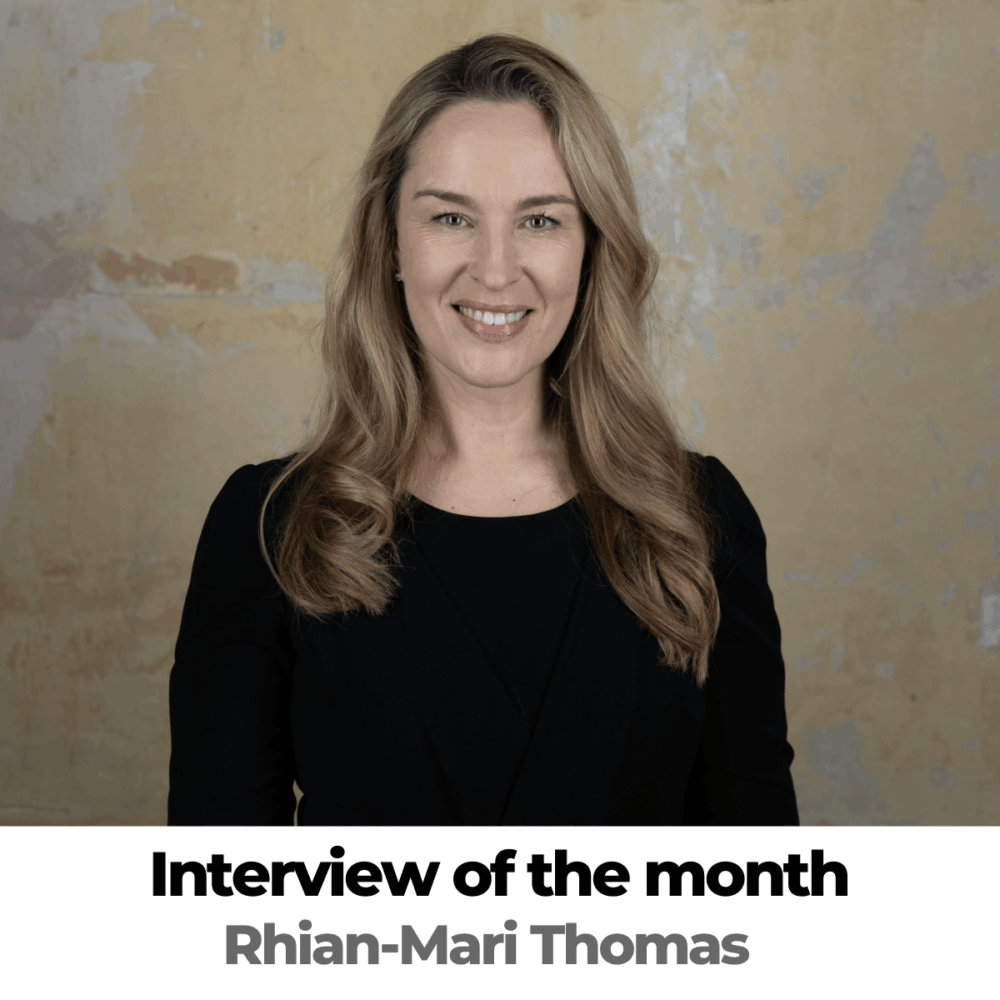
Interview of the month: Rhian-Mari Thomas
This month, we spoke with Rhian-Mari Thomas, CEO of the Green Finance Institute, about why bridging science, finance, and policy is essential to accelerating the transition. In this interview, she explains how her background in physics shaped her ability to cut through complexity, structure solutions, and build high-impact teams, and how profitability and investability became the core of her strategy for driving change from within major financial institutions.
In this interview, she shares why she moved into the policy–finance nexus to maximize impact, and how the GFI’s model of “ruthless pragmatism” has unlocked real-economy solutions, from scaling the UK green mortgage market to pioneering work on carbon removals, sustainable fuels, and nature finance across nine countries.
You started your professional journey with a PhD in Physics. How did that foundational scientific discipline shape your approach to finance? How has this unique lens helped you advocate for and implement change?
I’ve often wondered if I was attracted to Physics because I like the notion of taking complex ideas and reducing them down into manageable concepts, or whether doing Physics for so long actually honed that skill. I think it’s possibly a bit of the two.
For the first half of my banking career, this background was hugely helpful. I used to structure complex leveraged finance transactions for private equity clients, which required acquiring a lot of knowledge in short periods of time and applying it to find the optimal capital structure. That ability, acquired through physics, of sorting through swirling masses of noise and information and homing in on what is key to the outcome was extremely helpful.
It’s clear, when you look at the current challenges of climate change and nature degradation, why that training is so relevant now. That ability to cut through complexity, see a way forward, and focus rigorously on outcomes has been the basis on which we operate the Green Finance Institute (GFI).
I’ve tried not to hire in my own image, but ultimately, we’ve ended up with a very strong team that includes quite a number of former scientists.
Interestingly, I didn’t get to use Physics itself during my banking career, but that has come full circle now that I work on issues like climate change. I respect the laws of the market and legal systems, but neither of those hold a candle to thermodynamics and the laws of Physics, which really are inviolable. Ultimately, all our social laws will eventually yield to the fact that Physics underlies the change we have in our climate. We are going to have to find a way of incorporating that science into markets.
What were the key strategies you utilized to build a case for sustainability and drive the green agenda in the finance industry? What advice would you give to professionals, especially women, looking to grow their authority and lead systemic change in traditional industries?
The core strategy I have stuck to for moving the agenda forward was focusing on profitability and investability.
While I was a banker, I led a team that innovated about eleven different products in twelve months, and all of them successfully made money for the firm. That may feel uncomfortable, given the moral imperative of our agenda. One might be tempted to think we don’t need to adhere to financial fundamentals, however, that isn’t how large financial institutions work, it’s not their mandate, and it’s certainly not the route to success in that environment.
My advice to anyone embarking on this journey, whether in finance or any corporate setting, is that you need to be aligning what you do with the purpose of the organization.
If you’re in a profit-focused organization that needs to meet quarterly revenue targets, you must be doing something that helps the people who make money for that organization meet their targets and objectives. If you’re purely a gatekeeper or you get in the way of the organization doing successful business for its clients, you won’t succeed.
The key is to frame and equate what you do to the outcomes and objectives of those around you and make yourself invaluable as an expert. Provide insights and knowledge that are valuable for your clients and your organization, and help people get business done. It sounds obvious, but we often get so passionate about our agenda that we forget that crucial piece.
After a long, successful career in the private sector, what was the catalyst for your move to lead the Green Finance Institute (GFI)? Can you tell us more about what GFI aims to achieve and its approach?
My personal catalyst for moving into this space was maximizing my personal impact. I realized I could apply the skills I had learned in banking more effectively by working in an organization that collaborated closely with both the financial services sector and policymakers. I contend that this nexus—policymaking, finance, and industry—is the right part of the Venn diagram to win the fight against climate change.
The time constraint is what makes this battle challenging. If we had all the time in the world, the transition would happen naturally because the economics and technology increasingly make sense. But we must move quickly, and that requires policymakers to enable the transformation and financiers to facilitate it.
The GFI sits at the nexus of policymaking, finance, and industry. Our strategy is not to look at finance as a sector that needs greening, but to look at it as the facilitator of transition in the real economy.
We start by picking important sectors of the real economy that matter to both politicians and the financial sector, such as the built environment and mobility. We then ask experienced transactional finance people—who know what it takes for money to move—to pinpoint why capital isn’t flowing.
In the UK, for instance, we identified a failure to scale the green mortgage market. We painstakingly worked through all the hurdles that developers and mortgage banks raised to help them create their own green products. When we started, there were only three green mortgage products; now, there are over 91 in the UK, representing roughly 9% to 10% of the market. This process proved our model, which has been described as “ruthless pragmatism.”
We have since moved on to work in areas like carbon dioxide removals, sustainable aviation fuel, and nature finance. We are now in nine different countries. We only enter a new country when we are invited by both the finance community and the politicians.
The gap we are bridging is the “execution gap”:
- Governments are focused on transition (transforming the economy).
- The finance sector is focused on transactions (doing deals).
These two objectives require distinct strategies, and if they are not thoughtfully bridged, money won’t move. To solve this, our applicable discipline in every market—from Indonesia to Spain—is to focus on a clear sector and outcome and listen intently to what the finance sector says it needs to turn the transition into investable transactions.
At SFG we are looking at models for moving capital locally to enable the transition. GFI has taken a similar approach. Why do you take that approach? We noticed the UK has worked on Local Climate Bonds, for example. Has this instrument been effective and could it be applied in other contexts?
Our approach at the GFI has always been summarized by our strapline: “Channeling global capital to local solutions.” While global treaties and high-level norms are necessary, money ultimately moves into specific projects and between counterparties that are, by definition, local. We’re only going to succeed if we manage to convince people—local communities—that the transition is in their best interest. This means showing it will be positive for their pocketbook, health, and children’s future in a real, tangible way.
Moving to Local Climate Bonds (LCBs), they were developed by the crowdfunding platform called Abundance to fill a gap in the UK market: unlike other jurisdictions, local authorities in the UK don’t issue municipal bonds that retail investors can easily buy. LCBs allow local authorities to issue bonds, typically ranging from £500,000 to £1 million, that citizens can invest in for as little as £5. This enabled retail investors to buy in, resulting in over £18 million raised from almost 3,000 investors. Crucially, we successfully attracted the first institutional investors: Unity Trust Bank and the Esmee Fairbairn Foundation. Unity Trust Bank committed £15 million, and the Esmee Fairbairn Foundation committed to match-fund retail investments (up to £1 million). The potential is really impressive, with early research work in partnership with the University of Leeds suggesting this could be a £4 billion market in the UK alone.
Examining the global sustainable finance landscape, we’re reaching a critical point where pledges must be translated into concrete action and channel capital towards enabling a net-zero or net-positive economy. What do you identify as the biggest systemic hurdle that is currently preventing the industry from translating its significant capital and ambitious pledges into tangible, real-world impact at the necessary speed?
I’m glad you emphasized the need for speed.
One of the real challenges we face is that our solutions are often technical financial solutions. Financial institutions are full of people who are experts at structured and complex finance, but they all sit in one place. We collaborate with policymakers and local authorities who haven’t had the benefit of decades of this specialized training. Their cooperation, however, is critical to the success of these projects.
I keep seeing a capacity-building challenge. We need to figure out how to take specialist finance knowledge and make it more broadly distributed so that all parties can understand the technicalities.
The other major challenge is how to turn transitions into transactions. We often celebrate the launch of a new, sophisticated structure, but that’s really just the beginning. The celebration should be not when you’ve developed a sophisticated solution, but rather when the solution is so vanilla that institutional investors pile into it as a matter of course.
The smart, complex projects we do now are the “icebreakers.” But if we want to move from doing transactions to genuinely achieving transitions, we must replicate and make each of these solutions simpler each time so that they can be easily adopted at scale.
Despite the challenges, where do you see the most promising opportunity to scale sustainable finance right now?
I am a massive fan of—or rather, I’m going to “die on the hill” of shouting about guarantees.
I believe guarantees are how we are going to initially familiarize finance with new types of first-of-a-kind and early-of-a-kind sectors. These sectors are absolutely critical for the transition and are exciting hubs of entrepreneurial focus and innovation, but they often feature new business models in new jurisdictions.
We need to recognize that if commercial capital isn’t flowing into these opportunities, it’s primarily because the risk-adjusted returns are not as attractive as business as usual.
Guarantees provide a way to de-risk these opportunities so that private capital can be crowded in—which is the whole point. We want to help familiarize the market and build capacity.
I’ve been advocating for this for a long time, and I’m optimistic that the message is breaking through. The conversation about sustainable finance is becoming far more transactional—we’re talking about getting money to move rather than just creating frameworks. As I said in my remarks at Building Bridges, we’re like Taylor Swift in our new era, and I think this is going to be a really exciting one.