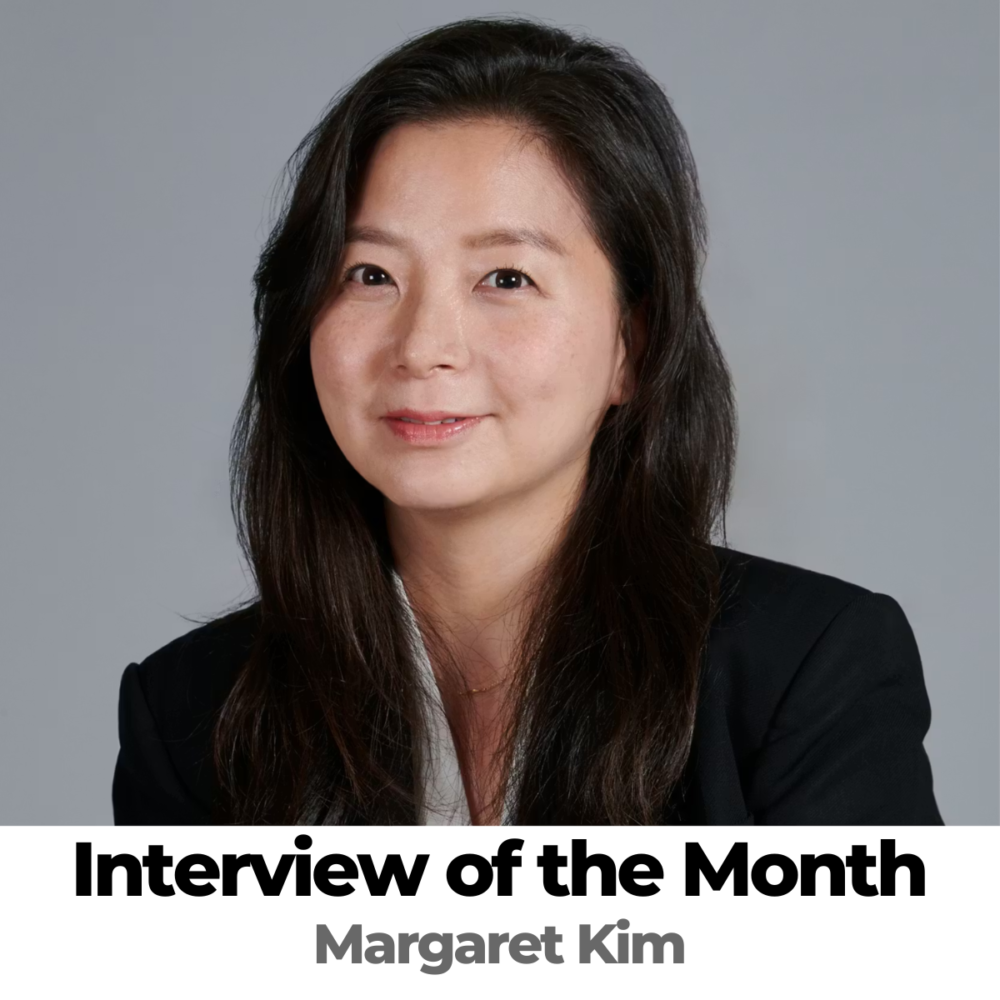
Interview of the Month: Margaret Kim
In this interview, Margaret Kim, CEO of Gold Standard, retraces the history of carbon markets since the organization’s founding in 2003, then explores the current challenges facing the market before turning to the roles and actors shaping its future, including financial institutions, asset owners, and standards bodies. Finally, she discusses how the private sector, multilateral institutions, and standards bodies can better collaborate. Margaret calls for a financial system that consistently directs capital to where it is most needed and most impactful, particularly in developing regions most exposed to the climate and environmental crisis.
Gold Standard was founded in 2003 by WWF and other NGOs out of a concern that carbon credits weren’t delivering real impact. More than 20 years later, how true does that founding concern still ring? How have carbon markets evolved in that time?
Gold Standard was founded by World Wide Fund for Nature and other NGOs to ensure that carbon markets deliver not just emissions reductions, but real, measurable sustainable development benefits. That principle is as relevant today as it was in 2003.
While carbon markets have evolved significantly, with stronger methodologies, greater oversight, and growing alignment with the Paris Agreement, the core challenge persists: ensuring that climate action with integrity translates into tangible outcomes for people and nature on the ground.
The next phase of the market must build on this foundation. Delivering climate impact alone is not enough; markets must also be accessible to those who need finance most and scalable in a way that drives broader sustainable development outcomes.
Carbon markets have faced several challenges recently from volatility in pricing to credibility questions. How can the challenges be addressed to ensure trust in the market remains strong? Where do you see new opportunities?
Trust will only increase if there is integrity in both the supply and demand side of the market: from project design and methodologies to credit issuance, use, and claims.
That means continuing to raise the bar: stronger methodologies aligned with the latest science and with the goals of the Paris Agreement, improved data and monitoring, and much clearer rules on how credits are used and communicated.
The opportunity is to move decisively from volume to value, directing finance toward high-integrity activities that deliver both climate impact and sustainable development outcomes, particularly in regions such as sub-Saharan Africa where there is significant potential for climate leadership and scale in carbon markets.
If we get that right, carbon markets can be a trusted, accessible and scalable channel for climate finance, rather than becoming a marginal or reputational tool.
What role(s) do you see for financial institutions or asset owners in carbon markets? What does responsible participation from the finance sector look like in practice?
Financial institutions have a unique opportunity to make a positive change in the world. Their influence extends across the whole economy through their financing and investment decisions. They can therefore have an outsized impact on our collective sustainability journey.
Often, the most meaningful action they can take is to shift capital towards more sustainable activities and support the decarbonisation of the sectors and companies they finance. This includes developing financial products and strategies that enable others to reduce their emissions in line with science-based pathways, while taking responsibility for those emissions that remain during their transition. It also means helping make high-integrity projects financeable and scalable—through long-term offtake agreements, blended finance structures, and risk-sharing mechanisms that channel capital to activities delivering real climate and sustainable development outcomes. Gold Standard has guidance on how organisations can do this, including through approaches such as internal carbon pricing.
For investors, responsible participation is not just about buying credits– it’s also about using their influence in financial systems to accelerate decarbonisation through strategic financing of solutions that supports carbon markets delivering integrity, accessibility, and scale.
There is growing interest in nature credits and markets, although there are concerns that it will be difficult to make nature bankable. What can nature markets learn from the experience of building carbon markets? Are there any distinct considerations we need to make for nature?
The key lesson from carbon markets is that integrity, accessibility and scalability must be built in from the outset, not retrofitted later.
We should be cautious about assuming that separate biodiversity credit markets are the answer. Nature is inherently local, complex, and difficult to standardise.
Instead, the focus should be on ensuring that climate finance delivers strong outcomes for nature and communities alongside emissions reductions. It is often impossible to separate nature and climate, and neither should we try to do so in all situations. Rather than developing an entirely new instrument, we should leverage what we have, through climate action with integrity that delivers for people and nature.
Financial institutions play a dual role: taking responsibility for their own environmental impacts, and mobilising capital for projects that protect and restore ecosystems. That means supporting approaches that integrate climate, nature, and sustainable development, rather than treating them as separate asset classes.
If we take that integrated approach, we can ensure finance flows to where it is most needed—while maintaining the integrity and impact that both carbon and nature markets depend on.
At Gold Standard we are actively considering how we can encourage more investment in nature. Please contact us if you are focused on similar issues and would like to work together.
You have spent your career moving between the private sector, multilateral institutions, and now a standards body. Having seen climate and nature action from so many perspectives, what do you think these different silos need to learn about each other to collaborate more effectively?
Each brings something essential:
- The private sector brings capital and speed
- Multilaterals bring legitimacy and policy alignment
- Standards bodies bring integrity and assurance
The gap is often in understanding each other’s constraints, incentives and the different ways we communicate about nature and climate action.
To collaborate effectively, we need solutions that are rigorous enough to ensure trust, but also practical enough to scale in real markets.
If you had a magic wand and could change one thing about the way the financial system currently treats climate and nature action, what would it be and why?
I would ensure the financial system consistently directs capital to where it is most needed and most impactful, particularly in regions that are least responsible for the climate and nature crisis but most exposed to its effects.
Today, too much capital remains concentrated in low-risk, mature markets, while high-impact activities in developing countries struggle to access finance. That is fundamentally an accessibility issue.
If we could correct that, through better risk-sharing, stronger market infrastructure, and clearer incentives, we would unlock far greater flows of finance into projects that deliver real climate and sustainable development outcomes.
Ultimately, this is about aligning the system so that integrity, accessibility and scalability are not trade-offs but reinforcing principles – and ensuring climate and nature finance reaches those who need it most.